Odd's accidental death by gunshot
Out Stealing HorsesLars’s accidental shooting of Odd is the irreversible turning point in the remembered summer: Jon’s gun, left loaded in the hall, becomes the means by which a child’s imitation ends in his twin brother’s death. The scene is recounted through Trond Sander’s uncertain reconstruction of his father’s account, holding the terrible fact against any consoling idea that the outcome had been destined.
Circumstances and the unattended gun
The day before the shooting, Jon had gone hare hunting, a familiar pursuit in which he was unusually successful: he had brought home two hares after firing two shots, both of which hit. He carried them by an ear on a cord and came back smiling, eager to show his parents. His mother was away visiting friends in Innbygda, and his father was in the forest. Jon had also forgotten that he was responsible for watching the twins.
In his hurry, Jon left his gun in the hall instead of putting it through the safety routine he normally followed. The gun mattered greatly to him: it was the only thing of value he owned, a gift from his father for his twelfth birthday, accompanied by firm instructions about what it should and should not be used for. At home, Jon habitually put it at half cock, removed the cartridges, and hung it on a high hook in the closet. This time, thinking of the twins alone in the house, he set it down without removing the last cartridge.
Jon searched the house and yard for the boys, then waded into the river beside the jetty and looked along both banks. He could find no trace of them. As he stood in the water, a shot sounded from the house. He ran back with wet, heavy trouser legs and squelching shoes. Halfway there, he saw his father running out of the forest. Jon had never seen him run before; the sight stopped him, and he sank onto the grass, already afraid that whatever had happened could not be undone.
The shot and its immediate consequence
The twins had spent the morning playing in the basement with discarded clothes and worn-out shoes. When they came upstairs, they saw the hares on the peg and the gun leaning against the wall. They knew it was Jon’s, and regarded their older brother as a hero whose actions could be turned into games. Lars reached the gun first, swung it around, and called for attention before pulling the trigger.
The recoil knocked Lars to the floor with a shriek. He had not aimed at anything; he wanted to hold the gun and imitate Jon. The shot could have struck several objects in the corridor: the woodbox, the small window over the steps, a framed photograph of their grandfather, or the unshaded light bulb that was left burning so that people outside would not lose their way in the dark. Instead, at close range, the bullet struck Odd in the heart.
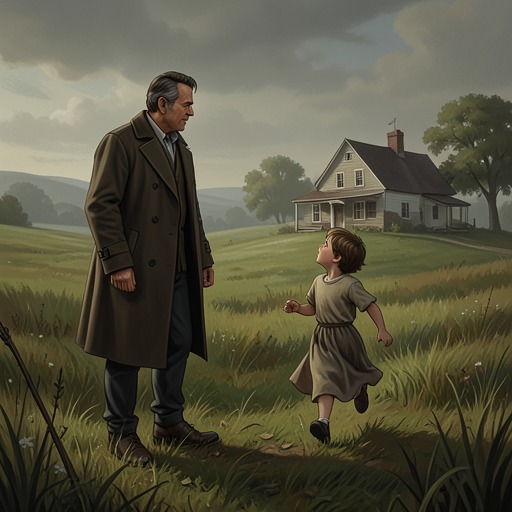
Jon’s father came out of the house carrying Odd in his arms. Jon remained huddled on the grass, seeing his father and understanding that the shooting had happened. The narration gives no extended account of what followed inside the house; its sharpest detail is the contrast between Jon’s habitual care of the gun and the single lapse that left it ready to fire, and between Lars’s game and the fatal result.
Retelling, responsibility, and fate
The scene reaches the reader as a memory shaped by Trond Sander’s father’s telling. Trond acknowledges that his father could not have supplied every detail in the remembered picture, and he cannot tell whether he began filling it out at once or did so over the years. He distinguishes that imaginative reconstruction from the facts he regards as uncontestable: the shooting happened, and Odd was killed. The distinction makes the scene both vivid and carefully qualified; its sensory particulars belong to memory’s rendering, while its central consequence is not in doubt.
The account explicitly resists the idea that the accident was written in the stars or predetermined by a book of destiny. The narrator imagines how a western might explain the shot as fate, but rejects that explanation: nothing in the event requires a supernatural design. The only book in which Odd’s name could not be crossed out was the church register. That image relocates inevitability from cosmic prophecy to the record of a death that has actually occurred, without making the accidental chain any less devastating.
In the remembered closing image, rain falls on the rushing river as Jon pushes off in a boat and lets the current carry him toward the house where he lives and where others are waiting. The image belongs to Trond’s reconstructed memory rather than a fully verified account of every moment after the shot. It leaves Jon suspended between the meadow where he stopped and the home toward which the river bears him, while the death itself remains fixed: a loaded gun left within reach, a child copying his brother, and a shot that cannot be recalled.